How a Multi-Location Southwestern Goodwill Improved Donation Processing with Brijjworks Thrift Production Manager
As this Southwestern Goodwill operation doubled revenue over the last four years, leadership faced a growing operational challenge: how to scale donation processing, production visibility, inventory management, and sell-through reporting without slowing down store operations.
To support that growth, the organization partnered with Retail Control Systems to implement Brijjworks Thrift Production Manager (TPM), a production and inventory management platform built specifically for thrift retail organizations.
The result was improved production efficiency, stronger inventory visibility, better reporting, and measurable productivity gains across production teams.
The Goodwill Challenge
Before Brijjworks Thrift Production Manager, the Goodwill organization relied heavily on manual production workflows and older systems, making it increasingly difficult to scale efficiently as donation volume and store operations grew.
Like many of its peers, the regional team needed a better way to manage:
- Donation processing
- Pricing consistency
- Seasonal inventory
- Production visibility
- Sell-through reporting
- Central processing
- Inventory movement across locations
Traditional retail inventory systems were not designed around donated goods environments,
where inventory changes daily and operational speed matters.
Brijjworks Thrift Production Manager Made Immediate Productivity Improvements
One of the first major improvements the organization saw after implementing Brijjworks Thrift Production Manager was a measurable increase in production productivity, which allowed for operational changes leadership had wanted to make for years.
During rollout, the Goodwill team compared Brijjworks Thrift Production Manager directly against their previous donated goods management software inside active stores. In the very first store implementation, the team using Thrift Production Manager saw an immediate increase in productivity, even while employees were still learning the new system.
TPM let us immediately get our arms around all of those changes that we wanted to make. We got to make them ourselves, and it made us 10 times more efficient.”
Director of IT at a Multi-Location Southwestern Goodwill
A major contributor to that improvement was Thrift Production Manager’s “stay screen” functionality and customizable icon-driven workflows.
Under the previous workflow, producers had to repeatedly navigate back through menus for every item they priced. Brijjworks TPM simplified that process by allowing team members to remain inside the same pricing workflow while processing multiple similar items.
That reduced repetitive clicks, simplified training, and helped merchandise move to the sales floor faster while empowering employees with varying levels of literacy and technology familiarity.
On a webinar with other Goodwills across the United States, the IT director emphasized how quickly the impact became visible: “That was like the first week. That was before they even knew where the buttons were in TPM.”
Better Visibility from Donation to Sales Floor
Brijjworks TPM’s dashboards, granular reporting capabilities, and API connectivity enabled the regional Goodwill to review custom operational and executive-level reports tailored to different teams across the organization, helping them better understand what merchandise was selling, which categories were underperforming, and where pricing adjustments were needed.
Built for Thrift Retail, Developed Alongside Goodwill
During development of Brijjworks TPM, this Goodwill partner played an important role providing real-world operational feedback and workflow collaboration, ensuring the TPM platform was built around real Goodwill production environments and donated goods workflows rather than generalized retail assumptions.
Traditional inventory systems often struggle in thrift environments because donated goods do not carry standard cost association.
Brijjworks TPM’s inventory management functionality was designed specifically to solve that gap by allowing thrift retailers to track:
- Central processing
- Seasonal inventory storage
- Inventory transfers
- Barcodes
- Department-level reporting
That visibility allows more control over merchandise movement while improving sell-through opportunities and reducing unnecessary rag-outs.
Mission Impact Through Operational Efficiency
Nearly 90 cents of every dollar generated in their stores goes directly toward mission services, making operational improvements far more than just a technology investment. Over the last four years, the organization has doubled its revenue and viewed operational modernization and openness to new technology as important components in helping them scale, and ultimately be able to fund more mission services.
About Brijjworks
Brijjworks is a commerce and operations platform built specifically for thrift retail organizations, including Goodwill, Salvation Army, Habitat for Humanity ReStore, St. Vincent de Paul, and independent thrift retailers.
Developed by Retail Control Systems (RCS), Brijjworks was created to solve the operational challenges unique to donated goods retail, where inventory is constantly changing and visibility from donation to sales floor is critical.
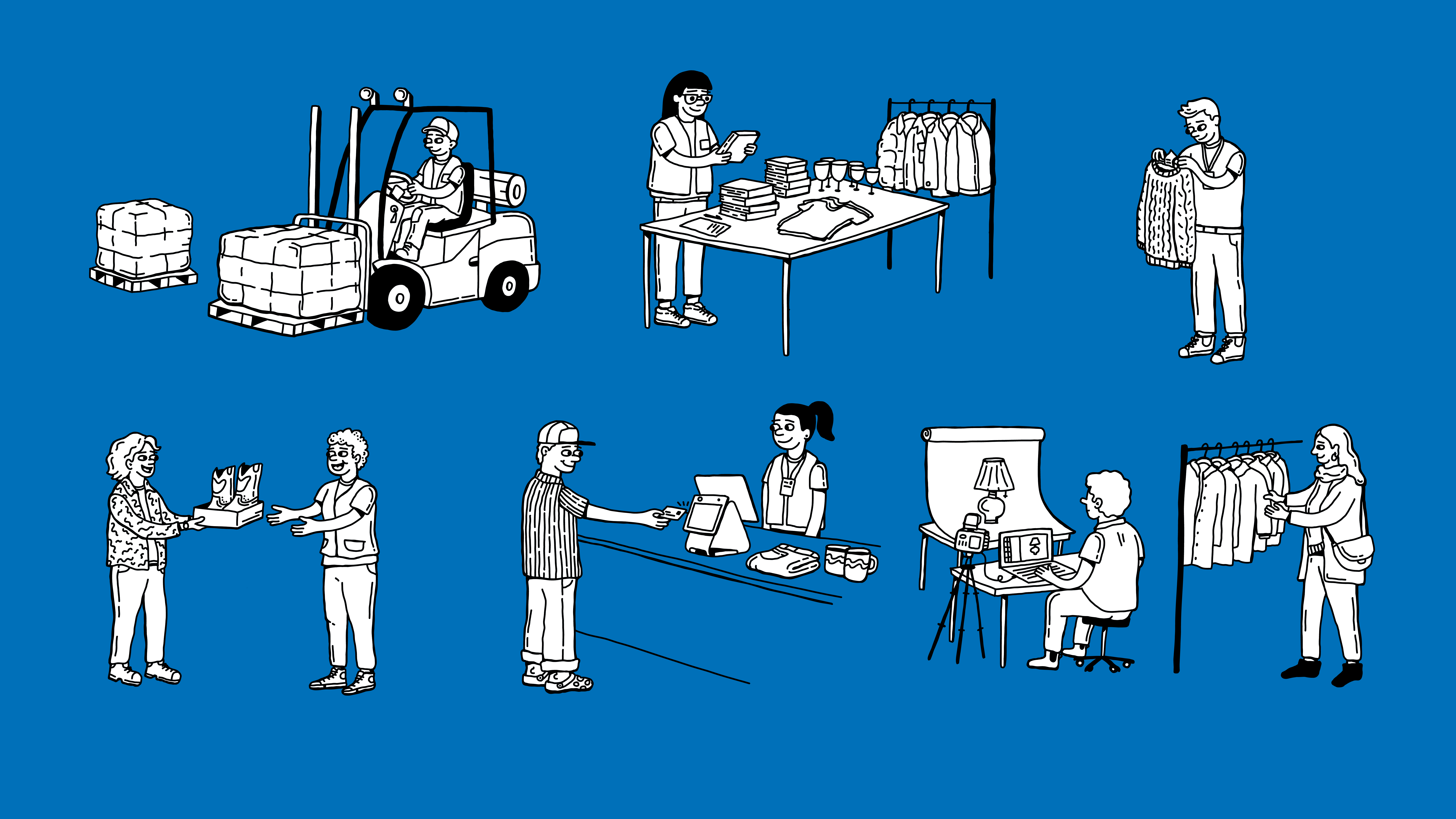
The platform connects production, donation management, inventory visibility, reporting, eCommerce, and point-of-sale into one unified ecosystem designed specifically for thrift retail operations.
Bridge the Gap Between Retail Technology and Mission Impact