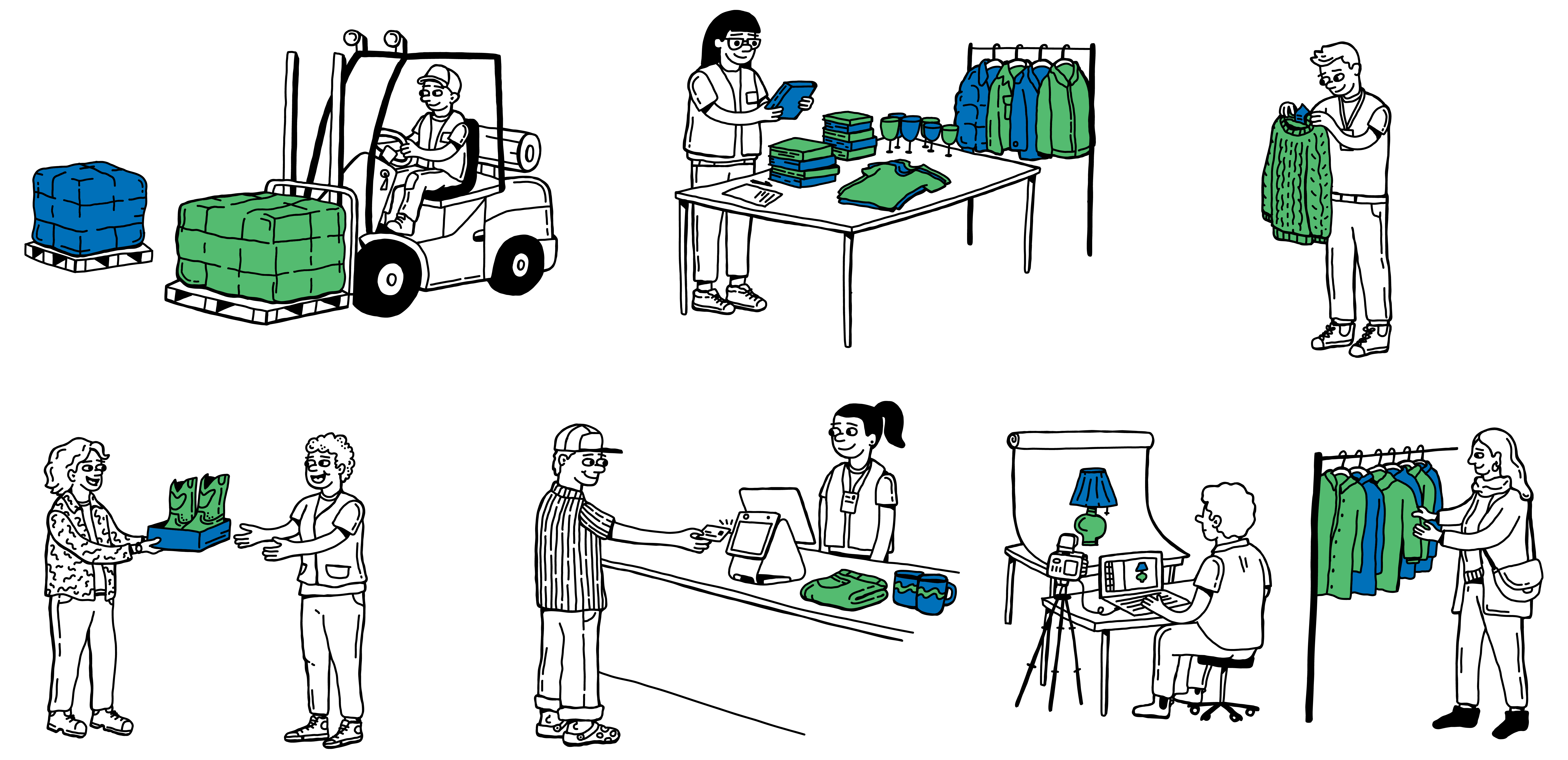
Whether you are onboarding a new team member or upgrading your technology, here is everything you need to fluently speak the language of thrift.
The Ultimate Thrift Retail Glossary
Thrift retail has its own language. Walk into any donation center or production room, and you’ll hear thrift terms that would leave traditional retailers completely scratching their heads.
From coordinating Color Weeks and moving Gaylords to analyzing sell-through and boosting Round Up participation, thrift organizations manage a highly unique ecosystem. Unlike traditional retail, every item follows a complex journey that begins with community donations and ends with real-world mission impact.
Over the years, we have had the privilege of partnering with incredible operators, gaining fluency in the specialized language that makes this industry tick.
Whether you are onboarding a new team member, evaluating software, or simply trying to decode what it means when someone says, “that Gaylord needs to go to central processing before Color Week changes,” we’ve got you covered.
Donated Goods Intake
Supply Chain & Back-of-House
Everything starts with a donation. Without donors, there is no inventory, no production, and no mission impact.
Donation
Inventory received from individuals, businesses, or organizations without a traditional purchase transaction.
Donation Center
A location dedicated to receiving donated goods from the community.
Donation Attendant
The team member responsible for receiving, unloading, and organizing donations.
Donation Volume
The total quantity of donated goods received during a specific period.
Donor
An individual or organization contributing donated goods.
Donor Retention
The percentage of donors who continue donating over time.
Donor Engagement
Activities designed to encourage repeat donations and strengthen donor relationships.
Donation Yield
The percentage of donated goods that ultimately generate revenue.
Donation Tracking
The process of monitoring donations throughout their lifecycle.
Donation Receipt
Documentation acknowledging receipt of donated goods.
Tax Receipt
A receipt provided for potential tax reporting purposes.
Donation Drive
An organized effort to collect donations from a community, school, business, or organization.
Drive-Up Donations
A donation process where donors remain in their vehicles while staff unload donations.
Average Daily Cars (ADC)
A metric commonly used to measure donor traffic at donation centers.
Donation-to-Sales Cycle
The amount of time it takes for a donated item to move from donation to sale.
Production is where donations become inventory. For many organizations, this is the heartbeat of the operation.
Production
The process of converting donated goods into retail-ready merchandise.
Producer
An employee responsible for processing, pricing, and preparing donated goods for sale.
Production Station
A workstation where merchandise is sorted, priced, tagged, and prepared for sale.
Production Goal
A target quantity or value expected from a producer during a shift.
Production Yield
The percentage of donated goods that become sellable inventory.
Production Visibility
The ability to track production activity, productivity, and outcomes.
Production Analytics
Reporting focused on production performance and results.
Throughput
The volume of merchandise moving through production during a specific period.
Pieces Per Hour (PPH)
A productivity metric measuring items processed per hour.
Pieces Per Labor Hour (PPLH)
A productivity metric comparing production output against labor hours worked.
Value Produced
The retail value generated through production activities.
Work in Process (WIP)
Donations received but not yet retail ready.
Sorter
An employee responsible for separating donations into categories.
Hanger
An employee responsible for preparing apparel for sale.
Batch Pricing
Pricing multiple similar items at one time.
Category Pricing
Pricing merchandise using category standards and guidelines.
Production Dashboard
A reporting view showing production performance and goals.
Work Queue
Inventory waiting to be processed.
The more locations an organization has, the more important inventory visibility becomes.
Inventory Visibility
The ability to understand what inventory exists, where it is located, and its status.
Inventory Aging
The length of time inventory remains available for sale.
Inventory Turn
A measurement of how quickly inventory sells and is replenished.
Backstock
Inventory stored off the sales floor.
Seasonal Backstock
Inventory intentionally stored for future sale during a more appropriate season.
Replenishment
Moving inventory from storage to the sales floor.
Store Allocation
The process of determining which inventory goes to which store.
Store Transfer
The movement of inventory between locations.
Central Processing
An operating model where donations are processed at a centralized facility.
License Plate
A unique identifier assigned to a Gaylord, pallet, rack, or inventory location.
Warehouse Inventory
Inventory stored outside retail locations.
Inventory Lifecycle
The complete journey of merchandise from donation through final disposition.
Staging Area
A temporary location where inventory waits for its next step.
Z-Rack
A rolling garment rack commonly used to transport and organize apparel.
Gaylord
A large corrugated bulk container used to sort, transport, and store donated goods.
Thrift Retail Sales
Omnichannel Retail & Customer Experience
Getting merchandise onto the sales floor is only part of the equation. The real goal is getting it sold.
Color Rotation
A merchandising strategy that uses color-coded tags to manage inventory aging and markdowns.
Color Week
The color assigned to merchandise produced during a specific week.
Color of the Week
The inventory color currently receiving promotional discounts.
Rotation Cycle
The complete lifecycle of merchandise from production through removal.
Scan Pull
The process of removing aged inventory from the sales floor.
Rag Out
Merchandise removed from the sales floor after reaching the end of its selling cycle.
Rag Rate
The percentage of inventory that exits through rag-out.
Sell-Through Rate
The percentage of produced inventory that ultimately sells.
Fresh Goods
Recently produced inventory placed on the sales floor.
Markdown
A reduction in selling price intended to increase sell-through.
Floor Ready
Merchandise that has been processed and is ready for display.
Sustainability & Mission Impact
Aftermarket & Organizational Purpose
The point-of-sale captures the data, but reporting turns it into insights.
Point-of-Sale (POS)
The system used to process customer transactions.
Transaction
A completed customer purchase.
SKU
A unique identifier assigned to merchandise.
Customer Account
A customer profile containing purchase history and engagement data.
Reporting Dashboard
A visual summary of operational performance.
Retail Analytics
Reporting used to evaluate sales, inventory, and customer performance.
Average Ticket
The average dollar amount spent per transaction.
Units Per Transaction (UPT)
The average number of items purchased per transaction.
Gross Sales
Total sales before returns and adjustments.
Sales Velocity
The rate at which inventory sells.
Great thrift organizations don’t just build relationships with donors. They build relationships with customers too.
Loyalty Program
A customer rewards program designed to encourage repeat visits.
Loyalty Member
A customer enrolled in a loyalty program.
Loyalty Enrollment Rate
The percentage of customers joining a loyalty program.
Customer Retention
The ability to keep customers returning over time.
Customer Lifetime Value (CLV)
The estimated revenue generated by a customer over time.
Promotion
A marketing campaign designed to increase traffic or sales.
Flash Sale
A short-duration promotional event.
Discount Event
A temporary pricing promotion.
Personalized Promotion
A promotion targeted to specific customers.
VIP Program
A loyalty program designed for highly engaged customers.
Customer Rewards
Benefits offered to encourage repeat shopping.
Not every item belongs on the sales floor. Some deserve a much larger audience online.
Lister
An employee responsible for identifying, researching, photographing, and listing merchandise online.
Listing
An item published for sale online.
E-Commerce Item
Inventory designated for online sale.
Spotter
An employee responsible for identifying premium or high-value merchandise.
Premium Item
An item expected to generate above-average resale value.
Cross Listing
Publishing inventory across multiple marketplaces.
Listing Conversion Rate
The percentage of listed items that sell.
Research Queue
Inventory awaiting identification or valuation.
ShopGoodwill
An online auction marketplace used by participating Goodwill organizations.
Online Sell-Through
The percentage of listed inventory that ultimately sells.
Customer Rewards
Benefits offered to encourage repeat shopping.
Sustainability & Mission Impact
One of the things that makes thrift retail unique is the number of ways organizations can recover value from donated goods.
Outlet
A retail format where merchandise is often sold by weight.
Outlet Recovery
Revenue generated from merchandise sold through outlet operations.
Salvage
Inventory removed from retail operations and sold through secondary channels.
Salvage Recovery
Revenue generated from inventory sold through salvage channels.
Commodity Revenue
Revenue generated from recyclable materials.
Textile Recovery
The recycling or repurposing of unsold textile goods.
Bale
A compressed bundle of recyclable materials.
Baler
A machine used to create bales.
Circular Economy
An economic model focused on reuse and extending product life.
Landfill Diversion
Keeping reusable goods out of landfills.
Recommerce
The resale of previously owned merchandise.
Why These Thrift Retail Terms Matter
The world of thrift retail is evolving quickly. Today’s organizations need crystal-clear visibility into everything from donations and production to customer engagement, sustainability, and mission performance.
The operations that thrive over the next decade won’t just be great at processing goods; they will be experts at understanding the entire lifecycle of a donated item. From the initial drop-off to the final Round Up at checkout, every single step matters.
We hope this thrift retail glossary helps your team master the essential thrift terms needed to stay ahead of the curve and build a more efficient, impact-driven organization!
For nonprofit thrift organizations, retail isn’t the finish line. It’s the engine that helps fund something bigger.
Mission Impact
The community benefit generated through retail operations.
Mission Revenue
Revenue generated to support nonprofit programs and services.
Round Up
A checkout giving program that allows customers to round purchases up to the nearest dollar.
Round Up Rate
The percentage of transactions participating in Round Up.
Round Up Revenue
Funds generated through checkout giving programs.
Community Investment
Resources directed toward local programs and services.
Revenue to Mission
The percentage of retail revenue supporting mission activities.
Mission Sustainability
The ability to support long-term mission programs through retail operations.
Donation Impact
The environmental and community benefit created by donated goods.