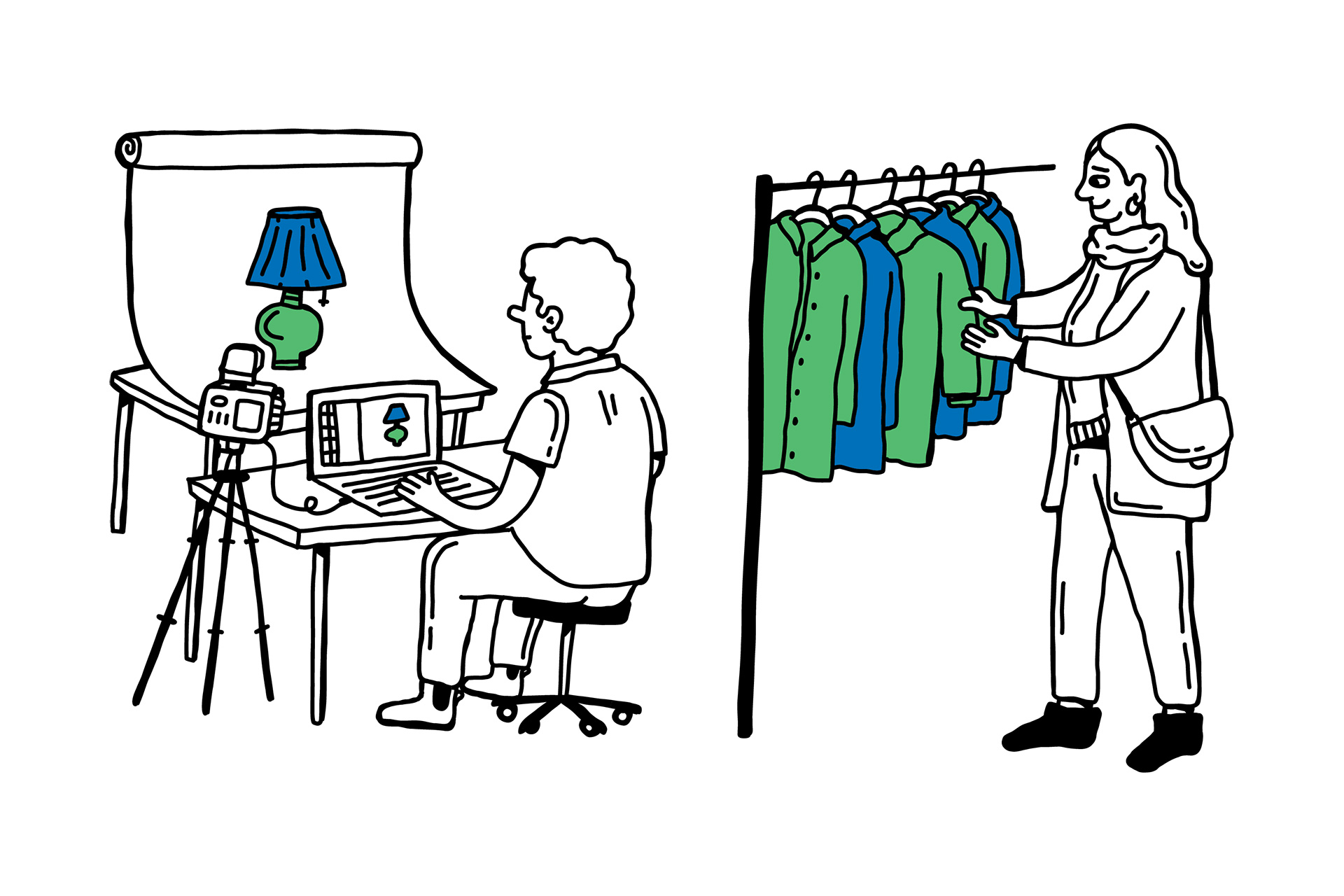
In the world of thrift, the physical storefront has always been the heart of the mission. There is a specific magic to the “treasure hunt”—the tactile experience of thumbing through a rack of pre-loved flannels or discovering a mid-century lamp tucked in a corner. For decades, the industry has operated on the belief that thrift is inherently an offline, local business.
But “local” is no longer a geography; it’s a starting point.
The reality of modern retail is that your customers are already shopping for secondhand goods online. They are on Poshmark, eBay, Depop, and Facebook Marketplace. If your high-value donations are only sitting on a shelf in a brick-and-mortar store, you aren’t just missing sales; you are limiting the reach of your mission.
At Brijj, we’ve seen the shift across specialty retail and donation centers: growth happens when you stop viewing “online” as a separate business and start seeing it as a broader door to your existing inventory.
Overcoming the Challenges of Thrift Store Ecommerce
The most common hesitation we hear from operations leaders is that ecommerce is “too complicated” for the unique, one-of-a-kind nature of thrift. The logic usually goes: “We have too much volume and too much variety to list everything online. It’s easier to just put it on the floor.”
This is a valid observation of a legacy workflow, but it’s a myth that it has to stay that way.
Thrift is not “inherently offline.” It is simply operationally intense. When your systems aren’t built for multi-channel resale, the friction makes ecommerce feel like a chore rather than a growth engine.
- When a staff member has to take a photo on a personal phone and manually type a description into eBay.
- When you have to “pull” an item from the floor because someone bought it online, but you can’t find it.
- When your online sales data lives in a separate spreadsheet that never talks to your POS.
Retail gets harder when your digital strategy is an afterthought. But when you bridge the gap between the backroom and the web, the “treasure hunt” doesn’t disappear—it just scales.
eBay vs. Owned Webstores: Finding the Right Resale Balance
A modern ecommerce strategy isn’t about choosing one platform; it’s about choosing the right destination for the right item.
The Power of Marketplaces
Platforms like eBay or specialized resale sites give you immediate access to millions of “high-intent” buyers. If you have a rare pair of 1990s sneakers, the person willing to pay top dollar likely isn’t walking through your front door today—but they are searching for those exact shoes on their phone right now. Marketplaces are your tool for specialized value.
The Strength of an Owned Storefront
Your own website is where you build your brand and your community. It’s where you capture the “regular” thrift shopper who wants to support your specific mission. This is the home for your “curated” collections or seasonal drops. An owned storefront is your tool for recurring loyalty.
The goal of a unified platform is to manage both without doubling the workload. You should be able to “list once, sell everywhere.”
Inventory Selection: How to Pick Your Online Winners
You shouldn’t list every $4 t-shirt online. The labor cost of photography and shipping would eat your margin. High-performing thrift retailers use an “Identify & Elevate” framework to decide which items move to the digital shelf.
What should you sell online? Your “Digital-First” Items:
- Good Brand Recognition: Items with a “searchable” brand name (e.g., Patagonia, KitchenAid, Bose).
- Rarity/Vintage Appeal: Unique items where the “market price” is significantly higher than your standard floor price.
- Niche Collectibility: Pottery, furniture, toys, or accessories.
When your production team has the “Quiet Partner” of a smart listing tool, this triage happens at the point of intake. A processor identifies a “High-Value” item, clicks a button, and the item is routed to the “Lister” queue instead of the “Floor” rack.
Why BOPIS (Buy Online, Pick Up In-Store) is Essential for Thrift
The future of thrift isn’t just shipping boxes across the country; it’s using the internet to drive people into your physical stores. This is the BOPIS (Buy Online, Pick Up In-Store) model.
BOPIS is a game-changer for thrift because it eliminates the biggest friction point of ecommerce: shipping costs. When a local customer sees a beautiful mahogany dresser on your website, they can buy it instantly to “claim” it, then drive over to pick it up. This hybrid model does two things:
- It ensures you don’t lose the sale to someone else while the customer is “thinking about it.”
- It gets the customer into your store, where they are statistically likely to buy three more things once they arrive.
A hybrid model feels different to the customer. It provides the convenience of Amazon with the soul and mission of a local non-profit.
The Operational Pitfall of Disconnected Systems
The “chaos” of ecommerce usually stems from “disconnected tools.” If your online store is an island separate from your physical POS, you are inviting two major headaches: Ghost Inventory and Data Blindness.
Ghost Inventory is the nightmare of selling an item online that was already sold on the floor twenty minutes ago. It leads to cancelled orders, frustrated customers, and “dings” on your marketplace ratings.
Data Blindness is the inability to see your true “sell-through.” If you don’t know that your designer handbags sell 4x faster online than in-store, you can’t make informed decisions about your production priorities.
Effective ecommerce requires a unified inventory. When an item is listed, it is “locked” in the system. When it’s sold, it’s removed everywhere. This isn’t just a technical feature; it’s the foundation of trust—for both your team and your customers.
The Brijj Tie-In: Lister + Unified Commerce
At Brijj, we built Lister specifically to handle the “one-of-a-kind” complexity of thrift. It isn’t a generic ecommerce tool; it’s a production engine designed for high-volume donated goods.
With Brijj, your thrift store ecommerce strategy moves at the same pace as your floor:
- Rapid Listing: Capture photos and details in a mobile-first interface designed for speed.
- Marketplace Integration: Automatically push your high-value finds to eBay or your owned storefront with a single tap.
- Unified Inventory: Your POS and your online store share the same brain. No ghost inventory. No manual reconciliations.
- Simplified Fulfillment: Ship from the backroom with integrated label printing and tracking.
When your technology is aligned, the “Quiet Side of Automation” takes over. You aren’t “running an ecommerce site”; you are simply giving your best donations the audience they deserve.
The Shift: From Local Store to Digital Powerhouse
Thrift will always be about the community. But in a digital world, your “community” is anyone with a smartphone and an appreciation for a great find.
When point of sale, web listings, and inventory are aligned, a production manager’s shift feels different. They aren’t just sorting through bins; they are curating a global storefront. They have the clarity to know what to sell, where to sell it, and how much it’s worth.
Retail will always move fast. Your technology should move with you, giving your team the confidence to unlock new revenue and grow your mission.
Frequently Asked Questions About Thrift Ecommerce
1. Isn’t ecommerce too labor-intensive for one-of-a-kind thrift items?
Traditional ecommerce is slow because it’s built for bulk. However, a thrift-specific lister automates the tedious parts. By using mobile-first tools to snap photos and AI-assisted descriptions, a production team can list a unique item in under 60 seconds. The key is only “elevating” items that meet a specific value threshold.
2. How do I prevent selling the same item online and in-store simultaneously?
This is the “Ghost Inventory” problem. The solution is Unified Inventory Management. When an item is scanned into your ecommerce queue via Brijj, it is “locked.” If it sells online, the POS is notified instantly; if it’s scanned at the register first, the online listing is pulled down in real-time.
3. Which is better for thrift: eBay or my own website?
Both serve different purposes. Marketplaces (eBay, Etsy) are best for rare, high-value items because they provide immediate access to a global audience. Your own website is better for curated collections and building local loyalty. A “unified” strategy allows you to list to both simultaneously without doubling your work.
4. How does BOPIS (Buy Online, Pick Up In-Store) help my mission?
BOPIS drives digital traffic into your physical locations. It’s perfect for heavy items (like furniture) that are expensive to ship. It secures the sale immediately while the customer is browsing online and physically brings them into your store, often leading to additional “treasure hunt” purchases.
5. Do I need to hire a separate team to manage online sales?
Not necessarily. Most high-performing stores integrate ecommerce into their existing production workflow. By equipping your current “back-of-house” staff with the right tools, they can identify and list high-value items as they sort, rather than making it a separate, secondary process.